
1 Million Jobs Revised: What the 2025 BLS Employment Benchmark Means for Employers
By Kevin Welch, CEO & Founder, Journey Payroll & HR
Published: February 2026
Last updated: February 2026
In its annual benchmarking update, the U.S. Bureau of Labor Statistics (BLS) revised 2025 payroll employment downward by approximately 1 million jobs.
That headline can sound alarming, but know it’s not a collapse as the numbers may seem. It is a statistical correction, but an important one.
For employers, HR leaders, CFOs, and operational decision-makers, this 2025 BLS benchmark revision meaningfully changes how last year’s labor market strength should be interpreted.
This article explains: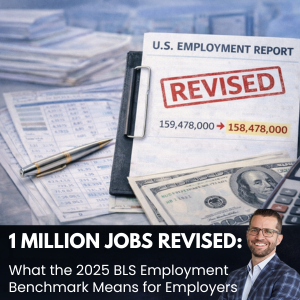
- What the 1 million job revision means
- How the BLS annual benchmark revision works
- What the employment revision is and what it is not
- Why the 2025 employment data adjustment matters for workforce planning
What Is the BLS Annual Benchmark Revision?
The monthly employment numbers released throughout the year are preliminary estimates derived primarily from the Current Employment Statistics (CES) survey, which samples employers across industries.
Because these are survey based estimates, they are subject to revision.
Each year, the BLS conducts a formal reconciliation process known as annual benchmarking.
During this process:
- Survey based payroll employment estimates are compared against more complete administrative records, including state unemployment insurance tax filings.
- Employment levels are adjusted to align with this broader dataset.
- Historical monthly figures are revised to reflect the updated employment totals.
The purpose of benchmarking is long term accuracy.
However, when the gap between survey estimates and administrative records is large, revisions can be significant.
For 2025, the benchmark revision reduced the level of payroll employment by approximately 1 million jobs, lowering the year-end total from about 159.5 million to 158.5 million.
The More Important Shift: 2025 Job Growth Was Overstated
While the 1 million figure attracts attention, the more meaningful impact is on job growth.
Initial reports indicated that approximately 584,000 jobs were added in 2025. Following the benchmark revision, actual net job growth appears closer to 181,000. That represents roughly a 70% reduction in previously reported job growth.
The labor market did expand in 2025, but far more modestly than initially believed.
For employers, the difference between “steady expansion” and “minimal growth” materially changes strategic assumptions.
What the 1 Million Job Revision Is
The 2025 employment revision is:
- A statistical recalibration based on more complete administrative data
- A correction to employment levels and annual job growth
- A refinement of how strong labor market momentum actually was
It reflects the limitations of real time survey estimation and the normal process of reconciling preliminary data with finalized records.
This revision changes our understanding of 2025 labor market strength, not today’s current payroll count.
What the 1 Million Job Revision Is Not
The benchmark adjustment is not:
- 1 million new layoffs
- A sudden drop in active payroll employment
- Automatic confirmation of recession
- A policy announcement or regulatory action
Total U.S. payroll employment remains near 158–160 million jobs nationally.
A 1 million adjustment represents approximately 0.6% of total employment.
Benchmark revisions occur annually. However, a downward adjustment of this magnitude is among the larger employment revisions seen in recent decades.
Why the 2025 Employment Revision Matters for Employers
Labor market data directly influences business strategy.
When 2025 appeared to reflect steady job growth and continued labor tightening, many organizations planned accordingly:
- Expanding hiring pipelines
- Budgeting for continued wage pressure
- Assuming sustained turnover risk
- Forecasting strong labor demand
- Accelerating expansion plans
A slower-growth reality changes those assumptions.
A labor market that is cooling behaves differently than one that is accelerating.
For employers, this may influence:
- Compensation strategy and wage pacing
- Offer competitiveness
- Overtime utilization
- Hiring timelines
- Workforce expansion plans
- Capital investment decisions
Strategic workforce planning should align with the most accurate interpretation of labor market conditions available.
Practical Workforce Planning Considerations for 2026
In light of the 2025 BLS benchmark revision, employers should consider the following:
- Treat Monthly Labor Reports as Directional
Preliminary employment reports provide timely insight but are subject to revision. Strategic decisions should incorporate flexibility rather than assume early estimates are final.
- Reforecast Workforce Plans Quarterly
In dynamic economic environments, annual planning cycles are often insufficient. More frequent recalibration reduces exposure to narrative shifts.
- Monitor Internal Workforce Metrics Closely
Operational indicators often provide more actionable insight than national labor data. These include:
- Voluntary turnover rates
- Time-to-fill positions
- Offer acceptance rates
- Overtime costs and usage
- Revenue per employee
- Productivity trends
National employment data provides a macroeconomic context. Internal workforce data drives tactical and financial decisions.
Strategic Takeaway
The economy did not experience a sudden contraction in 2025.
However, job growth was meaningfully weaker than it appeared in real time.
The 1 million job benchmark revision does not signal collapse, it signals recalibration.
For business leaders, the lesson is not alarm.
It is discipline.
Employment data evolves as more complete information becomes available. Organizations that build adaptable workforce strategies are better positioned to respond when economic narratives shift.
Early data informs.
Revised data refines.
Strong employers adjust accordingly.
About Kevin Welch
Kevin Welch is the Founder and CEO of Journey Payroll & HR, where he advises employers on payroll strategy, workforce planning, employment law risk management, organizational culture, and broader business operations. He works with business owners, HR leaders, and financial decision-makers to align labor strategy with evolving economic and regulatory realities.
He believes strong businesses are built through disciplined execution, clear communication, and a leadership culture that values both performance and the people behind it.