
How Payroll Supports Ethical Pay Practices
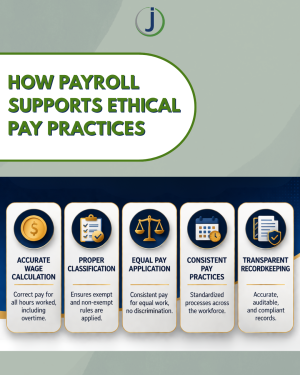 Short answer: Payroll supports ethical pay practices by ensuring employees are paid accurately, consistently, and in compliance with federal wage laws. Ethical pay is not subjective. It is grounded in correct wage calculations, proper classification, equal pay application, accurate recordkeeping, and transparent payroll processes. Payroll is where pay equity, compliance, and fairness are executed every pay period.
The U.S. Department of Labor’s Wage and Hour Division enforces laws designed to protect workers through minimum wage, overtime, and recordkeeping standards. These laws exist to ensure fair and consistent treatment across the workforce.
Ethical pay practices are not separate from compliance. They are built through compliant payroll systems.
What This Is
This article explains how payroll systems support ethical pay practices through compliance with federal wage laws, accurate calculations, transparency, and consistency in how employees are paid.
What This Is Not
This is not a philosophical discussion of fairness or compensation strategy. It is not a benefits or compensation design guide. It is a compliance-based explanation of how payroll operationalizes ethical pay.
Who This Applies To
This applies to employers in the United States that process payroll and are subject to federal wage and hour laws, including the Fair Labor Standards Act (FLSA).
Who This Does Not Apply To
This does not apply to businesses that do not process payroll or do not employ workers. It does not cover independent contractor payments outside of payroll systems.
Why Ethical Pay Matters in Payroll
Ethical pay practices are enforced through federal law. The Fair Labor Standards Act establishes minimum wage, overtime requirements, and recordkeeping standards that define baseline fairness in compensation.
The Department of Labor’s mission is to ensure compliance with these standards to protect the welfare of workers.
When payroll systems fail, ethical pay breaks down. Underpayments, misclassification, and inconsistent calculations are not just errors. They are compliance failures that directly affect employees.
How Payroll Supports Ethical Pay
- Accurate Wage Calculation
Payroll ensures employees are paid correctly for all hours worked, including regular wages, overtime, and additional compensation. Federal law requires overtime pay at one and one-half times the regular rate for hours worked over 40 in a workweek.
Accurate calculations are the foundation of ethical pay.
- Proper Employee Classification
Payroll must apply correct classification rules for exempt and non-exempt employees. Misclassification is one of the most common causes of wage violations.
Ethical pay requires that employees eligible for overtime receive it.
- Equal Pay Application
Federal law prohibits wage discrimination based on sex for substantially equal work.
Payroll systems support this by applying consistent compensation structures and ensuring that pay differences are based on legitimate, documented factors.
- Consistent Pay Practices
Ethical pay requires consistency. Payroll ensures that employees performing similar work under similar conditions are paid using the same rules, schedules, and calculations.
Inconsistent payroll processes create inequity.
- Transparent Recordkeeping
Federal law requires employers to maintain accurate records of hours worked and wages paid.
Transparency in payroll records allows employers to demonstrate compliance and allows employees to understand how their pay is calculated.
- Timely Payment
Ethical pay includes paying employees on time. Payroll systems ensure that wages are delivered according to established pay schedules without delay.
Delayed pay creates both legal and ethical issues.
Important Facts About Ethical Pay and Payroll
- Ethical pay is enforced through federal wage laws, not opinion.
- Payroll is responsible for executing those laws correctly every pay period.
- Errors in payroll directly impact employee earnings and trust.
- Recordkeeping is a legal requirement and a transparency tool.
- Equal pay laws apply to all forms of compensation, not just base wages.
Common Misunderstandings
“Ethical pay is just about paying more.”
This is false. Ethical pay is about paying correctly and consistently under the law.
“Payroll just processes what HR decides.”
This is false. Payroll applies legal standards that directly affect compensation outcomes.
“If no one complains, payroll is fine.”
This is false. Compliance issues often exist long before complaints or audits occur.
Real-World Examples
- An employer misclassifies employees as exempt and fails to pay overtime. Payroll corrects classification and recalculates back pay, restoring compliance and ethical wage treatment.
- A company applies inconsistent bonus calculations across departments. Payroll standardizes the calculation method, ensuring equitable compensation.
- A business lacks accurate time tracking. Payroll implements structured recordkeeping, improving both compliance and transparency.
What Employers Should Do
Employers should ensure payroll systems are configured for compliance, regularly audit wage calculations and classifications, maintain accurate records, apply consistent pay practices, and address discrepancies immediately.
Ethical pay is not a one-time decision. It is a system built and maintained through payroll.
What Employees Should Know
Employees should understand that payroll determines how wages are calculated and applied. They should review pay statements, understand overtime eligibility, and raise questions when pay does not align with hours worked.
Accurate payroll protects employee earnings and rights.
How Journey Payroll & HR Can Help
Journey Payroll & HR helps employers build payroll systems that support ethical pay practices through compliance. We ensure accurate wage calculations, proper classification, consistent pay application, and audit-ready recordkeeping.
We help employers identify risks before they become violations and align payroll processes with federal wage laws.
At Journey Payroll & HR, payroll is treated as compliance every pay period. Ethical pay is not a policy. It is a process — and payroll is where it happens.