
What Happens During a Federal Payroll Compliance Review?
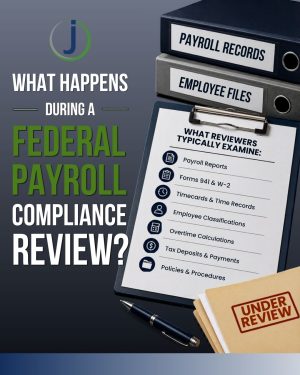 Short answer: During a federal payroll compliance review, agencies such as the IRS or U.S. Department of Labor examine payroll records, tax filings, wage calculations, employee classifications, and timekeeping practices to determine whether employers are complying with federal payroll laws. Employers may be asked to provide payroll reports, Forms 941 and W-2, employee records, overtime calculations, and supporting documentation. If issues are identified, employers may owe back wages, penalties, taxes, or corrective action.
Federal payroll reviews are not random paperwork exercises. They are structured investigations designed to verify compliance with federal tax and wage laws.
According to the IRS, employment tax examinations review whether employers are properly reporting and paying employment taxes and complying with worker classification requirements.
This article explains what happens during a federal payroll compliance review, what agencies examine, and how employers should prepare.
What This Is
This article explains the federal payroll compliance review process, including IRS employment tax audits, Department of Labor wage investigations, requested records, review procedures, and possible outcomes.
What This Is Not
This is not legal advice for a specific audit or investigation. It is not state labor department guidance. This article focuses specifically on federal payroll compliance reviews involving IRS and Department of Labor processes.
Who This Applies To
This applies to employers in the United States that process payroll, withhold employment taxes, and are subject to federal wage and hour laws.
Who This Does Not Apply To
This does not apply to businesses without employees or organizations that do not process payroll under federal law.
Why Federal Payroll Compliance Reviews Happen
Federal agencies conduct payroll compliance reviews to verify that employers:
- Correctly calculate wages and overtime
- Withhold and deposit payroll taxes properly
- Classify workers correctly
- Maintain required payroll records
- File accurate payroll tax returns
Reviews are often triggered by:
- Employee complaints
- Payroll tax discrepancies
- Late or incorrect filings
- Worker misclassification issues
- Inconsistent wage reporting
- Statistical irregularities in payroll records
The IRS vs. Department of Labor Review Process
-IRS Employment Tax Reviews
The IRS focuses primarily on:
- Employment tax reporting
- Payroll tax deposits
- Worker classification
- Forms 941, W-2, and 1099 accuracy
- Federal tax withholding compliance
The IRS reviews whether reported payroll tax information matches supporting records and tax law requirements.
-Department of Labor Reviews
The Department of Labor focuses primarily on:
- Minimum wage compliance
- Overtime calculations
- Hours worked
- Employee classifications
- Recordkeeping requirements under the FLSA
DOL investigations typically focus on wage-and-hour compliance rather than tax reporting.
Step 1: The Employer Receives Notice
Most federal payroll reviews begin with a formal notice or contact from the agency.
The notice generally identifies:
- The type of review
- The time period being examined
- Records requested
- Deadlines for response
IRS audits often begin by mail.
Step 2: Payroll Records Are Requested
Payroll documentation becomes the center of the review process.
Agencies commonly request:
- Payroll registers
- Timecards and timekeeping reports
- Forms 941 and 940
- W-2 and W-3 filings
- Employee pay records
- Tax deposit confirmations
- Classification documentation
- Payroll policies and procedures
According to IRS audit guidance, examiners review books, records, and financial documents to verify compliance with tax laws.
Missing or inconsistent records significantly increase compliance exposure.
Step 3: Payroll and Time Data Are Examined
Federal reviewers compare payroll records against:
- Tax filings
- Timekeeping systems
- Employee classifications
- Reported wages
- Overtime calculations
The review is designed to identify inconsistencies between reported payroll activity and actual payroll practices.
Common review areas include:
- Unpaid overtime
- Misclassified employees
- Missing time records
- Incorrect tax withholding
- Unreported compensation
- Late payroll tax deposits
Step 4: Employee Interviews May Occur
In Department of Labor investigations especially, employees may be interviewed regarding:
- Hours worked
- Pay practices
- Overtime treatment
- Meal and break policies
- Off-the-clock work
Investigators use interviews to verify whether payroll records accurately reflect actual work practices.
Step 5: Findings Are Issued
After reviewing records and interviews, the agency determines whether violations occurred.
Possible outcomes include:
- No change or no violation findings
- Requests for additional documentation
- Back wage assessments
- Additional employment taxes owed
- Civil penalties
- Interest assessments
- Required payroll corrections
- Expanded investigation scope
According to the IRS, audits may conclude with no change, agreed corrections, or disputed findings.
The Biggest Payroll Risks During Reviews
Worker Misclassification
One of the most common issues involves employees improperly classified as exempt or independent contractors.
Overtime Errors
Incorrect overtime calculations remain one of the most frequent federal wage violations.
Poor Recordkeeping
Federal law requires employers to maintain accurate payroll and time records. Missing records often create major problems during reviews.
Payroll Tax Discrepancies
Late deposits, incorrect Forms 941, and wage reporting mismatches increase IRS scrutiny.
Important Facts Employers Must Know
Federal payroll reviews examine both wages and taxes
Payroll records are the foundation of the investigation
Employers remain responsible even when using payroll providers
Employee interviews may occur during DOL reviews
Missing documentation increases compliance exposure
Reviews may expand beyond the original issue identified
Common Misunderstandings
“A payroll review means the company did something illegal.”
This is false. Reviews are examinations, not automatic findings of wrongdoing.
“If payroll software handled the calculations, the employer isn’t liable.”
This is false. Employers remain legally responsible for compliance.
“Only large companies face payroll reviews.”
This is false. Employers of any size may be reviewed.
Real-World Examples
An employer receives an IRS employment tax review notice after inconsistent payroll tax filings. The IRS requests payroll registers, Forms 941, and tax deposit records.
A Department of Labor investigation begins after an employee overtime complaint. Investigators compare time records against payroll reports and discover off-the-clock work issues affecting multiple employees.
A rapidly growing company fails to maintain organized payroll records. The lack of documentation expands the scope and complexity of the review.
What Employers Should Do
Employers should:
Maintain organized payroll records
Reconcile payroll tax filings regularly
Audit classifications and overtime calculations
Retain timekeeping documentation
Respond promptly and professionally to agency requests
Review payroll systems proactively before issues arise
Payroll compliance reviews are easier to manage when documentation is accurate and consistent.
What Employees Should Know
Employees should understand that federal payroll reviews are designed to ensure wage and tax compliance. Employees may be interviewed about pay practices, hours worked, and payroll procedures during investigations.
How Journey Payroll & HR Can Help
Journey Payroll & HR helps employers prepare for payroll compliance reviews through accurate payroll processing, audit-ready recordkeeping, classification analysis, and payroll tax reconciliation.
We help employers identify compliance gaps before agencies do and build payroll systems designed to withstand federal scrutiny.
At Journey Payroll & HR, payroll is treated as compliance every pay period. Federal payroll reviews are not just about records — they are about whether payroll practices hold up under examination, and we help employers prepare for that standard.